Candles Clip Art All Grey Thank You Note Clip Art
Building shadows: A Lighting and Shading Tutorial
34,432 views
INTRO
Hullo! I'm Weiwei, and I've been cartoon digitally for a few years at present and I'd similar to share some tips and fundamental theory about lighting and shadows. I hope yous acquire something ~
This tutorial is designed for people who already are familiar with basic CSP tools such as layer blending modes (MULTIPLY, GLOW DODGE, etc.), locking transparent pixels, and clipping layers to other layers. ClipStudio has official guides explaining these functions, so check those out if y'all need. However, I promise there's something useful here for artists of all feel levels!
1. Setup
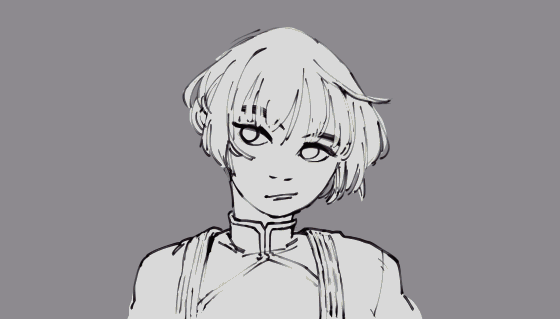
I'll be using this sketch of my original character, Yan, every bit an example. Information technology's a adequately unproblematic drawing so I have simply 3 layers right now - the lineart, all the base colours on one layer, and the grey background. I like working on gray rather than white because it's more than neutral and lets me choose colours meliorate later on. It'south also easier on my eyes.
Don't worry about colouring exactly in the lines right now, having a few (not too many) imperfections gives the art a more than natural and spontaneous look. I personally like putting base of operations colours down roughly with the Chip HUSKY India Ink castor, to get some natural texture. Yous'll be hearing a LOT about the Scrap HUSKY brush... information technology's my fave :)
^Witness my favourite CSP default brush. It can do everything and anything!!
Now, let's make the drawing more interesting by adding shadows and lighting!
It helps to think of lights and shadows using game engine logic. Realistic-manner 3D game engines like Unity use central physics principles and 3D shaders to generate shadows and change the objects' colours accurately. Unfortunately I'thousand not a robot/estimator programme (and hopefully, neither are you!) so I can't replicate those effects exactly, only understanding the logic behind it, and virtually how light actually affects color in real life, is a super valuable skill. More often than not, this ways:
>> Call up of your subjects as a 3D grade, not simply a flat 2D image.
>> Setting light sources offset, this determines where the shadows should be.
>> Adding other light interactions like ambient light, subsurface handful, diffuse and specular lighting, etc. Information technology can get every bit complicated and realistic every bit yous'd similar!
>> Finally some finishing touches similar environmental filters, object material, and details.
Let'southward go!
2. Constitute light source
To effigy out the best light source placement, I make lots of quick thumbnails of basic shadow placement. Ultimately I'm trying to express a certain mood or atmosphere, and the right shading/lighting will help me express that. Witness these lighting tests beneath:
Some notes on the thumbnails above:
Yellow arrows = light direction
If the light source is the SUN, all the low-cal can be considered to come from the same direction even if the sun radiates light in all directions, because information technology'south far away. In thumbnail iv, the calorie-free would be coming from a smaller source, like a flashlight or glowing object, to create those more rounded shadows.
1. Lite FROM Higher up - works great for outdoors settings under a loftier noon sun, or sitting within under a strong light bulb, etc.
ii. FRONT LIGHTING - usually generic/neutral and simple, puts more focus on the facial features and less on dramatic lighting. If yous don't want shading to be a highlight of the cartoon, you can't go wrong with forepart lighting!
3. SIDE LIGHTING - having one-half her face in shadow can be cool and dramatic, specially with very dark shadows
iv. Lite FROM BELOW - scary/dangerous vibe, unremarkably during nighttime, peradventure she's property something glowing like a candle?
v. Dorsum LIGHTING - it can have an "epic" kind of feeling. If this was a picture of Yan in activity/fighting pose, dorsum lighting would be great.
vi. ANGLED LIGHTING - a diagonal calorie-free source is natural and neutral, has lots of possibilities for mood
These aren't all the lighting options possible, I just picked some common ones. For example, I haven't fully explored having multiple lite sources, light source altitude and size, or playing with low-cal exposure in these tests... I'll save those for some other tutorial in the future!
For this tutorial, we'll continue with ANGLED LIGHTING (vi). Only regardless of the light source, the following lighting principles should always apply anyhow!
Quick note about method:
At this stage I shade with a neutral grey using the Scrap Husky pen with a giant brushtip - it provides some texture and lets some color of layers underneath show through, but information technology'due south subtle! The shadows are added on a new carve up layer on MULTIPLY setting and clipped to a folder containing both the flat colours and lineart layers. Left paradigm above is before changing the layer's blending mode/clipping, right image is later. By locking the transparent pixels of this shade layer, I can add together colour and more than texture subsequently.
three. Calorie-free interactions - colour, cast shadows & ambient calorie-free
So far, it looks quite manifestly and flat with only basic shadows. Light interacts in many other ways to create visual effects that can add interest to the drawing. This is where we brand the shadows more realistic.
SHADOW Color.
A full general rule y'all may accept heard before is Warm lights = cool shadows, and vice versa. This isn't entirely accurate, a better mode to remember of it is - warm light = areas lit by the light volition exist warmer, therefore the shadows will exist cooler than the lit areas. then, cool light = lit areas volition exist cooler than usual, therefore shadows will exist warmER compared to the lit areas.
For this drawing, I want a warm yellow sunlight on a sunny day (the blueness of the sky will have negligible cooling consequence on the light color), so my shadows should be cool tone compared to the base colour. So, I lock the MULTIPLY-fashion shadow layer and colour over the grey with a neutral/de-saturated blue. Now the shadow has a cool tone.
V
Cast SHADOWS.
Any three-D object will be in shadow where less calorie-free hits it, and it will also cast a shadow onto things behind information technology as information technology blocks light from reaching there. I've already put some cast shadows at the beginning, bear witness in red here - mainly the shadow cast by the hair onto her face, and her caput onto her shoulder. I actually recall of these cast shadows together with shading the object itself, since they are similar enough.
Five
Bandage SHADOWS, contd.
However, y'all can add other elements into the drawing indirectly, by having those elements bandage a visible shadow. I add together a large purple-ish cast shadow over her face up to advise she's under a shelter/roof, creating a more melancholy/mysterious mood. And even if I'm non adding a proper background, I can add a shadow bandage by Yan'due south body and the roof that'south casting the shadow onto her face, to button the grey background dorsum in infinite.
5
^ Notation:
To quickly make a trunk shadow:
>> duplicate and flatten the line fine art and base of operations colour layers into a unmarried layer
>> lock transparency
>> fill with a neutral colour, I used a greyish blue
>> apply a Gaussian blur
>> voila!
AMBIENT Lite and Light OCCLUSIONS.
Ambient calorie-free is light that comes from other objects in the surround. For example, if Yan had a red apple on her shadowed shoulder, the apple would throw some redness into the shadows around it. Here, the major source of ambient lite would be from the sky. The sky is huge, so it would cast ambient low-cal from pretty much every direction.
Note - Ambient light theoretically hits the lit areas too, not just shadows, but it's much less noticeable under direct light so I but don't consider or add them in light areas of the drawing.
Lite OCCLUSIONS
The shadows cast past Yan's pilus onto her face would be shielded/occluded from ambient calorie-free.
Function of Yan's shoulder in the shadow cast past her shoulder is blocked from the sunlight and ambient light and so information technology would receive no low-cal at all - that'due south a total occlusion of low-cal and volition exist the darkest part of the drawing.
At that place are 2 ways I add ambient light, I'll show you both methods below, 1 with the cadre shadows and 1 with the large cast shadow.
Five
^ two ways to add ambient light
1. New layer on top of the shadow layer
>> ready to low opacity, normal blending
>> depict blue ambience lite in the shadows. I use the BIT Croaking brush to draw the shadows over again, then SOFT airbrush to erase some parts away, and then the shading is soft and gradual.
two. Same layer equally the cast shadow (which should exist on MULTIPLY blending mode)
>> pick a blueish colour
>> airbrush that colour on ambient light areas. (Left = normal blending way, Right = multiply)
Both methods are fine, just depends on how prominent y'all desire your ambience light to be!
4. Light interactions - subsurface scattering & direct light
SUBSURFACE Handful/Calorie-free BLEED.
This my favourite part! :)
When a light source is particularly stiff, some light will bleed into the midtones and shadow areas to create a super saturated-colour edge where the shadow meets light. This would be lite that penetrates through translucent materials like skin, so that information technology glows. Since the main light source hither is a yellowish sunlight, it might glow orange-red on her peel, and make a saturated brown edge on the shadows of her clothes and hair. I use the Chip HUSKY brush to add together some hard bleed edges, and the SOFT airbrush with a large castor tip on low opacity to add together broader, soft light bleeds. I draw the soft glows directly on the transparency-locked shadow layers, and the hard edges on a separate layer in NORMAL blending mode. Since it'south sort of hard to encounter them on top of the flat colours, witness hither the edges on a colourless base of operations also.
Note:
This edge only really shows up in DIRECT lite, so don't use it on all your shadows or else the drawing will lose focus. I common mistake I've noticed is, people over-use these light glows. I'm guilty of this too, because I dearest adding glows and shiny parts to my fine art! Merely if y'all limit the glow to a modest focus area (hither, the most saturated low-cal bleeds are only on Yan's face), the overall await you get is more than effective.
Direct LIGHT.
Do I want a very strong light source? If and so, some parts could be fully lit up to become white. Otherwise, a weaker light source may just make directly-lit areas simply a little lighter than the base of operations color. Left is the lights layer on GLOW Contrivance mode, and right is the same layer on SCREEN way and a lower opacity. GLOW Contrivance and SCREEN are my go-to layer modes for super-bright light and subtle/matte calorie-free, only feel free to play effectually with others!
I tend to also add together some light glow on a character'due south eyes too, even if information technology physically doesn't actually brand sense, because I want to have her optics pop and be function of the drawing's focal point.
V
5. Finishing touches/bonus
These are some actress things to consider, on meridian of everything else!
PLAYING WITH Low-cal COLOURS
I am going with a warm xanthous lite for this drawing, but it's always fun (and useful!) to test out alternatives! Using surreal glow colours like dejection and greens could give a "magical" vibe! Colours are a huge way to story-tell through your illustration.
You can too play with all the other shadow aspects in the cartoon. Since they're all on split layers, it'due south piece of cake to change individual parts - for case, if you find that a certain shadow or calorie-free effect is also prominent, y'all can e'er adjust the color and opacity without affecting the other shadows.
V
DEPTH.
Further objects aren't simply smaller, they also fade in saturation, detail, and sharpness. In outdoors scenes, the heaven's ambience will too have more upshot on distant objects, so they appear more blue/greyed out. Then, I brand her background take a blue tint, and I fade out some of her pilus in the back.
FOCAL POINT DETAILS.
The focal point of this drawing are the parts of Yan'due south face that are under sunlight. I but put more details around the focal expanse to reinforce its importance - so I keep the shadowed portions of her rather patently and flat, and put some single strands of pilus and cloth textures in the lit areas.
I too locked transparency on the line-fine art layer and coloured the lines scarlet where the lines were under straight light. This made it a lot less harsh than the original black lines!
V
OTHER THINGS TO CONSIDER.
Should the shadows accept hard or soft edges? How dark or light should my shadows exist? That depends on distance of light source among other things - harder edges and darker shadows tin imply a closer and smaller light source. Shadows softness tin also give information about the fabric of the object. I want Yan's jacket to be a thicker material and so I give it softer shading/less sharp shadows.than, for example, the shadow cast onto her shoulder.
Besides, you lot tin of course choose to go super stylistic with JUST hard edges or Only soft edges! Information technology's free real estate. Below is the piece with a list of all the layers it's made of, on the right!
Thank y'all! :)
Congrats for making information technology to the cease! Here's a GIF animation of the whole process, and the finished cartoon. In that location's definitely a lot more than cool effects light can create, but I want this tutorial to cover simply enough that you lot tin call back more than logically about how you design your shadows in your time to come art!
If you have any questions, comment beneath and I'll exist happy to answer them ~
Stay hydrated and stay classy. See you side by side time :)
If you lot'd like to follow me on social media, I'thousand incredibly online all the fourth dimension on twitter equally @peevishpants!
Users who liked this post
godwinwerflefougs.blogspot.com
Source: https://tips.clip-studio.com/en-us/articles/3002
Enregistrer un commentaire for "Candles Clip Art All Grey Thank You Note Clip Art"