How Long Can a Person Go Without Oxygen
How long can you go without air?
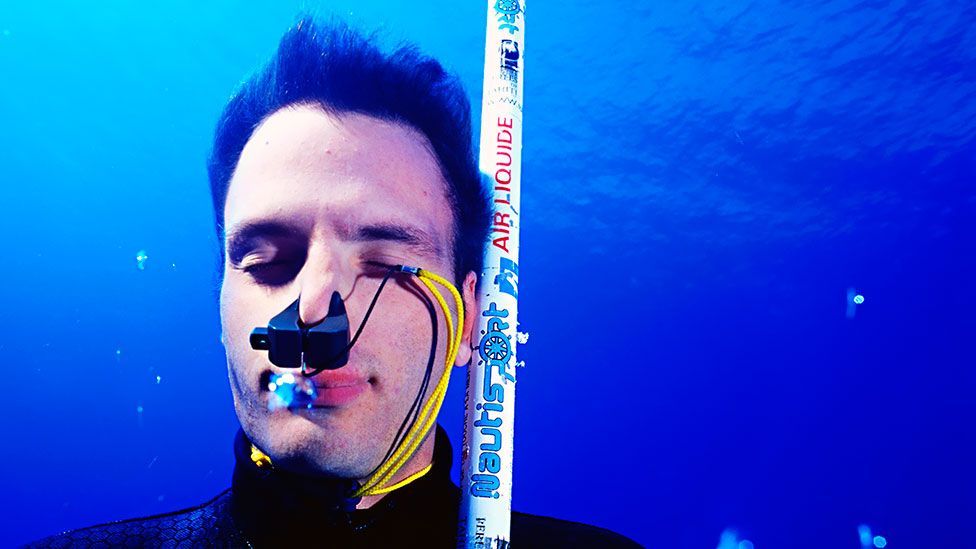
A few people tin can agree their breath for an astonishingly long time, discovers Frank Boyfriend. How do they do information technology?
L
Final November, 32-year-one-time Nicholas Mevoli lay on his dorsum on the body of water surface, gulping air like a fish to pack his lungs with air. Then with a small splash, he dove under the water and began swimming down into the Dean's Bluish Hole – an underwater cave in the Bahamas. Mevoli'due south goal was to reach a depth of more than than lxx metres (230ft) – and do information technology on a single breath of air. Information technology would end in disaster.
How long can someone stay underwater without surfacing? How long can anyone go without breathing? Every bit humans push button into our two final frontiers – deep space and the deep ocean – an agreement of our survival in airless environments is worth exploring.
In the emptiness of space, unconsciousness approaches very speedily. In 1965, a ruptured spacesuit briefly exposed a worker at Nasa's Johnson Infinite Facility to an virtually consummate vacuum in a exam chamber. He fainted after almost 15 seconds. Contrary to popular belief, he wasn't at risk from exploding, although at such a low pressure, exposed body fluids will vaporise at body temperature. His last memory before waking over again was the saliva boiling away on his tongue.
Freedivers, who swim down to the limit of their ability without scuba equipment, fare amend, regularly spending three minutes or more underwater. The freediver who holds the record for the deepest dive, Herbert Nitch, plunged to 214 metres (702ft) on a specially-designed submersible, remaining under the surface for four and a one-half minutes. Freedivers benefit from a concrete reaction known every bit the 'mammalian swoop reflex', which slows the middle when the trunk plunges underwater. (Even submerging the confront in cold water is enough to trigger this effect.)
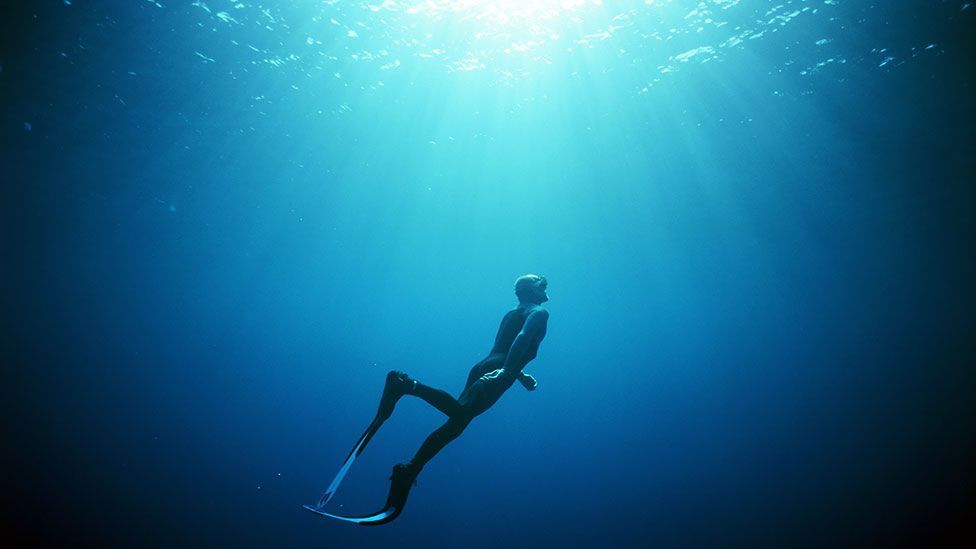
A freediver returns to the surface through rays of sunlight (Science Photo Library)
But although these dives are incredible for their crushing depths, we can last much longer in less extreme circumstances. Wallowing in the shallows of a London swimming pool, Danish freediver Stig Severinsen managed to hold his breath for 22 minutes in 2012, setting a world tape that has still to be beaten. How the professionals manage this, when average humans struggle to hold their breath for more a minute, comes down to preparation, preparation, and physiology.
Before his record attempt, Severinsen spent virtually 20 minutes hyperventilating with pure oxygen. This allowed his trunk to become saturated with oxygen, and also helped scrub his lungs of carbon dioxide. Both are important for long-term breath holding. While everyone knows that a lack of oxygen can be fatal, a build up of carbon dioxide tin be equally dangerous. Without the ability to excrete this waste production through our lungs, the steady build up of carbon dioxide in our blood will turn it into an acidic brew. Musculus spasms and disorientation follow, likewise as a racing heart and ultimately, death.
Trained freedivers and champion breath holders are probable to have built up physical adaptations that help them become long periods without breathing. A study of Brazilian fishermen found those who dived for prey had significantly larger lungs than colleagues who typically stayed above the surface. The famed Korean and Japanese pearl defined, meanwhile, were shown to flood their trunk with an extra 10% of cerise blood cells during their dives.
Upper limits
The limit of breath holding is dictated by how little oxygen and how much carbon dioxide yous can tolerate in your trunk. Both of those, however, are governed in turn by your metabolic rate. A diver pond through the ocean will use upward oxygen and produce carbon dioxide faster than i lying motionless in the water. Freedivers often speak of the demand for a meditative mindset in their sport – slowing their heart and emptying their listen to enter a state of deep relaxation. At that place are other ways to suppress metabolic activity. When US toddler Michelle Funk fell into an icy stream in 1986, she survived an estimated 66 minutes underwater, preserved by deep hypothermia that reduced her metabolic charge per unit to almost naught.
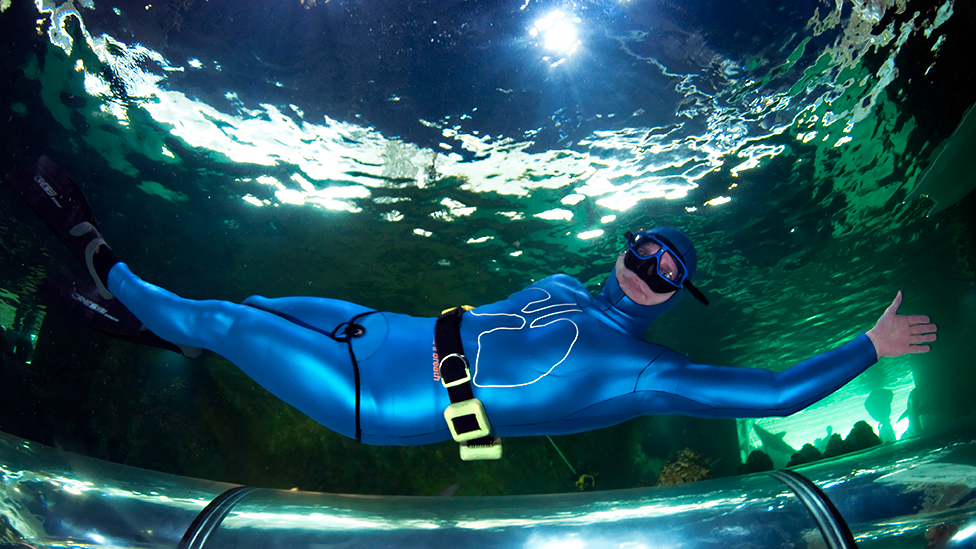
In 2012, Stig Severinson broke the world record for breath-holding (without swimming) with a fourth dimension of 22 minutes (Morten Bjoern Larsen/AP Photo/Polfoto)
The undisputed champions of everyday breath holding, yet, are diving mammals such as whales and seals. They can remain underwater for an hour at a fourth dimension before surfacing. Every bit well equally a higher tolerance for carbon dioxide in their bodies, these creatures have muscle tissue rich in myoglobin, which traps oxygen and releases information technology during long dives. Myoglobin, the poly peptide that lends meat its red colour, is so densely packed in whales that their flesh appears black.
Unfortunately, even the all-time training won't allow you to mimic the physical adaptations of whales. So are there any alternatives to life without air? Well, yes. You lot can try bending the rules a niggling by animate a liquid instead. Not pure liquid oxygen: at -200C, it would plough you into a man popsicle from the inside out and shatter your lungs the moment you tried to breathe. Instead, fluids that are rich in dissolved oxygen. A class of chemicals known as perfluorocarbons (PFCs) can deliquesce loftier concentrations of oxygen and carbon dioxide, and are liquid at much more comfortable temperatures. Liquid animate may sound like the stuff of science fiction – and indeed, it makes its most famous appearance in James Cameron's 1989 underwater chance The Abyss – just it has its roots in successful research.
Water breathing
Perfluorocarbons are attractive because they are colourless, odourless, and not-toxic – much like air – and because they would let defined to withstand high pressures when escaping from bedridden submarines. Experiments in the 1960s showed that mice and cats submerged in perfluorocarbon liquids could survive for days breathing the oxygenated fluid. As the fluid holds far more oxygen than the same volume of air, theoretically you might be able to hold your jiff a lot longer with one lungful of perfluorocarbon. Yet, the delicate structures of mammal lungs are non designed to withstand the force necessary to push four litres of liquid in and out of the body, making them a poor substitute for air over long periods, though liquid breathing has found some employ in treating premature babies, whose lungs are not withal able to inflate on their own.
Without new technology, nevertheless, tape breaking attempts are liable to end sadly. When Mevoli surfaced three and a one-half minutes afterwards his dive, he had reached a 'no fins' record depth at 72 metres (236ft). Only shortly afterwards, he lost consciousness, and despite receiving immediate medical treatment died shortly after. His death stands as a solemn reminder to the freediving community, and to the world, that life at the limits will always be a dangerous identify.
If you lot would like to comment on this, or anything else yous accept seen on Futurity, head over to our Facebook or Google+ folio, or bulletin us on Twitter .
A freediver descends into the body of water with the aid of a pole – some humans and animals tin concord their breath for an astonishingly long fourth dimension. (Science Photo Library)
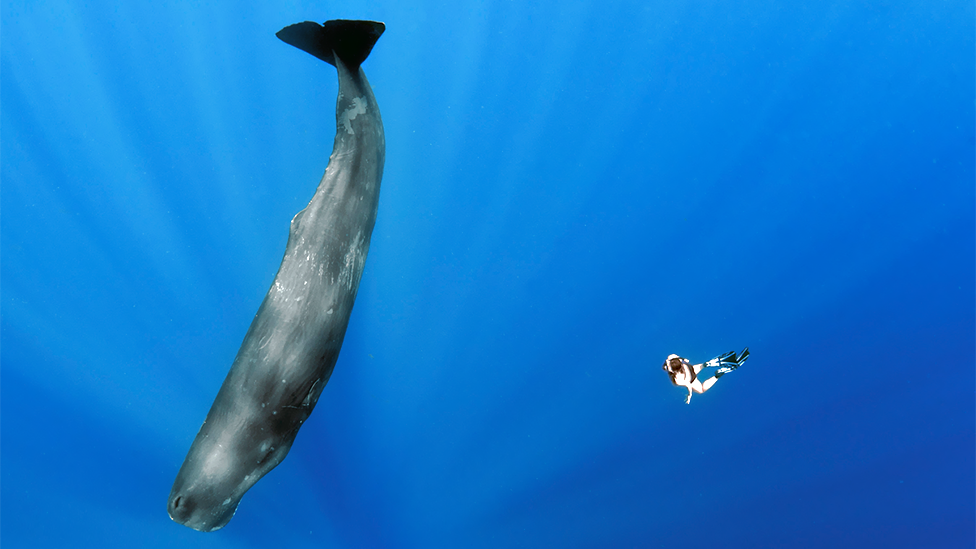
Sperm whales take been known to dive every bit deep as 2000 metres beneath the surface in search of food. That's approximately two hours of breath-holding. (Science Photo Library)
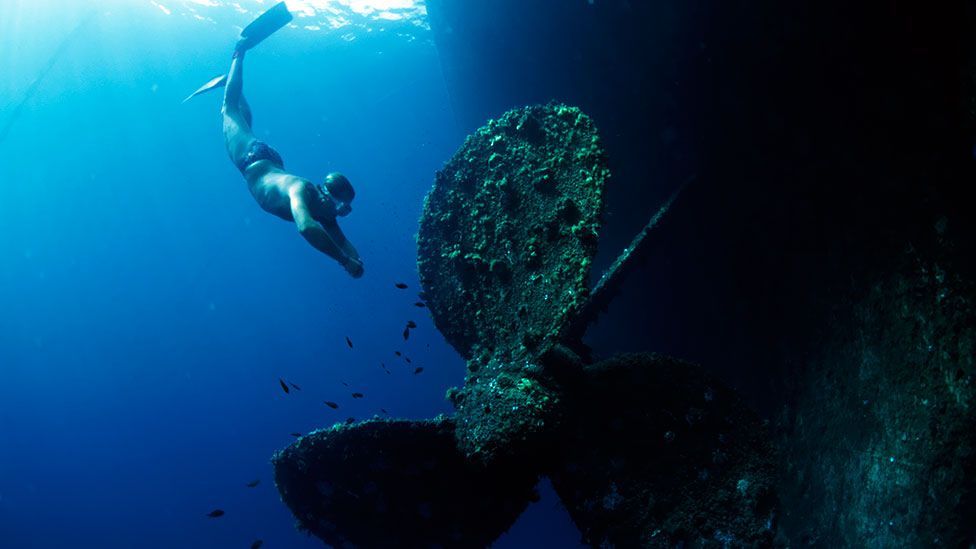
A diver approaches the wreck of a sunken ship. Freediving has been used in underwater salvage for thousands of years. (Science Photo Library)
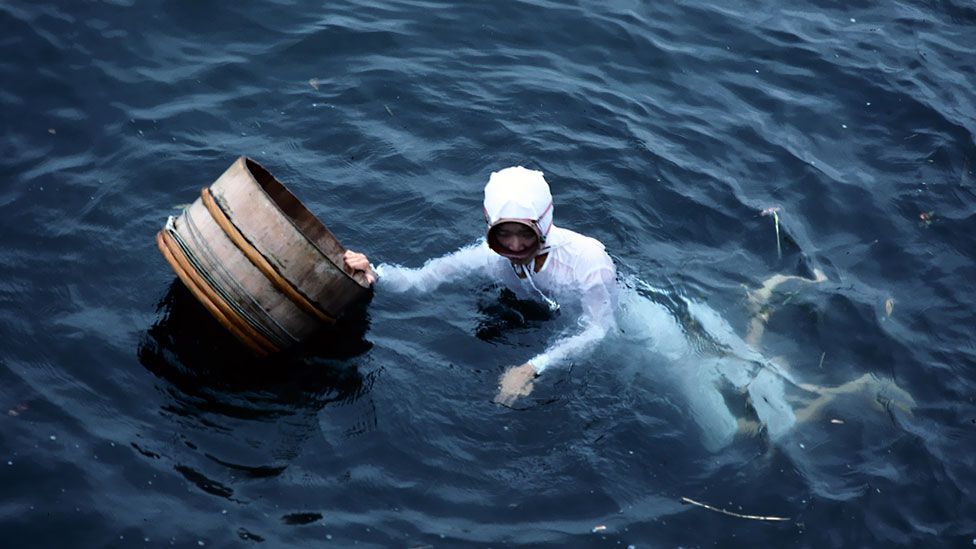
Pearl diving has been a characteristic of Japanese life for centuries. The 'ama' notwithstanding do non apply air tanks or scuba gear. (Science Photo Library)
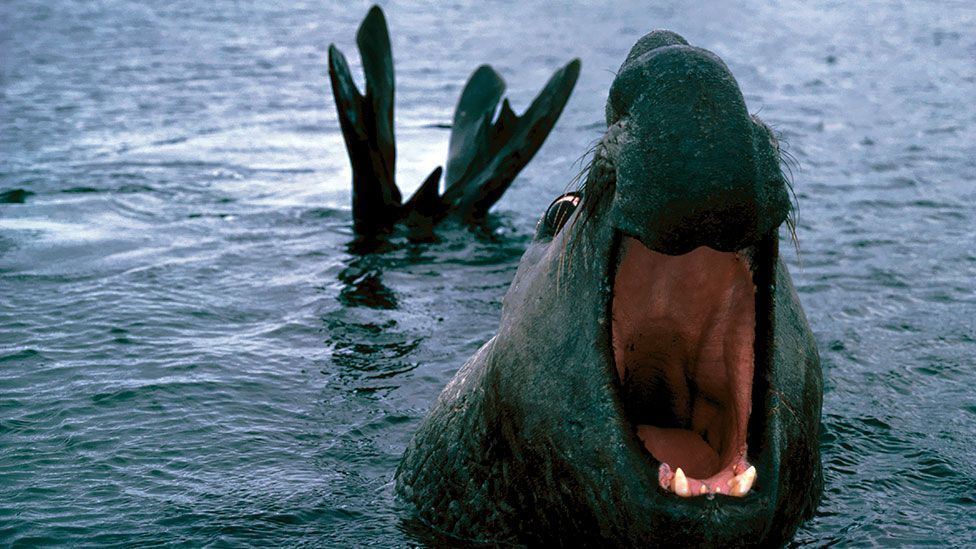
Some southern elephant seals tin stay underwater for over two hours in search of fish or squid to eat. (Science Photo Library)

Pete Colat is a 4-time record holder for breath-holding (without swimming), preparing by animate pure oxygen for upwardly to 30 minutes before submerging. (EPA/Ennio Leanza)
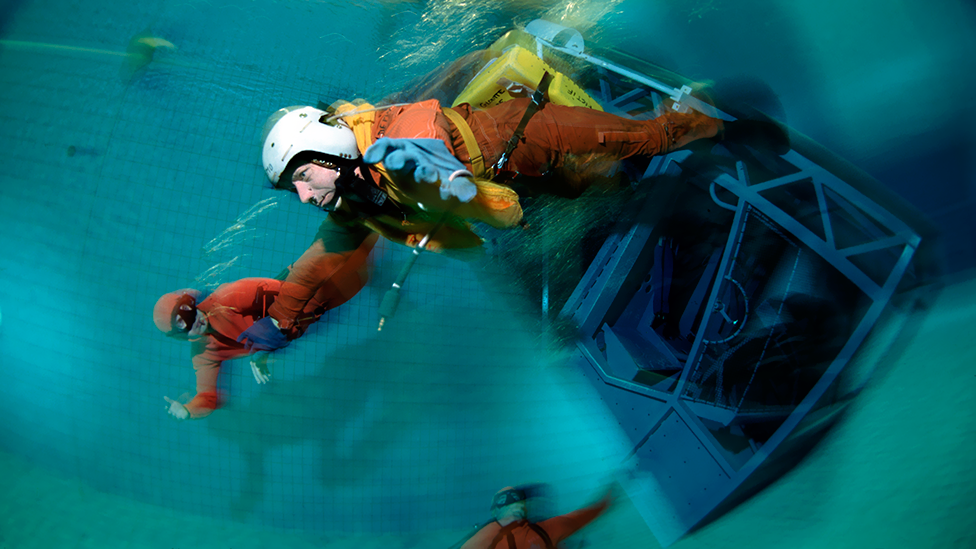
Breath-holding is part of the training for some jobs: a airplane pilot practises escaping from a submerged aircraft cockpit in Brest, France. (Science Photograph Library)
godwinwerflefougs.blogspot.com
Source: https://www.bbc.com/future/article/20140714-how-long-can-you-go-without-air

Enregistrer un commentaire for "How Long Can a Person Go Without Oxygen"